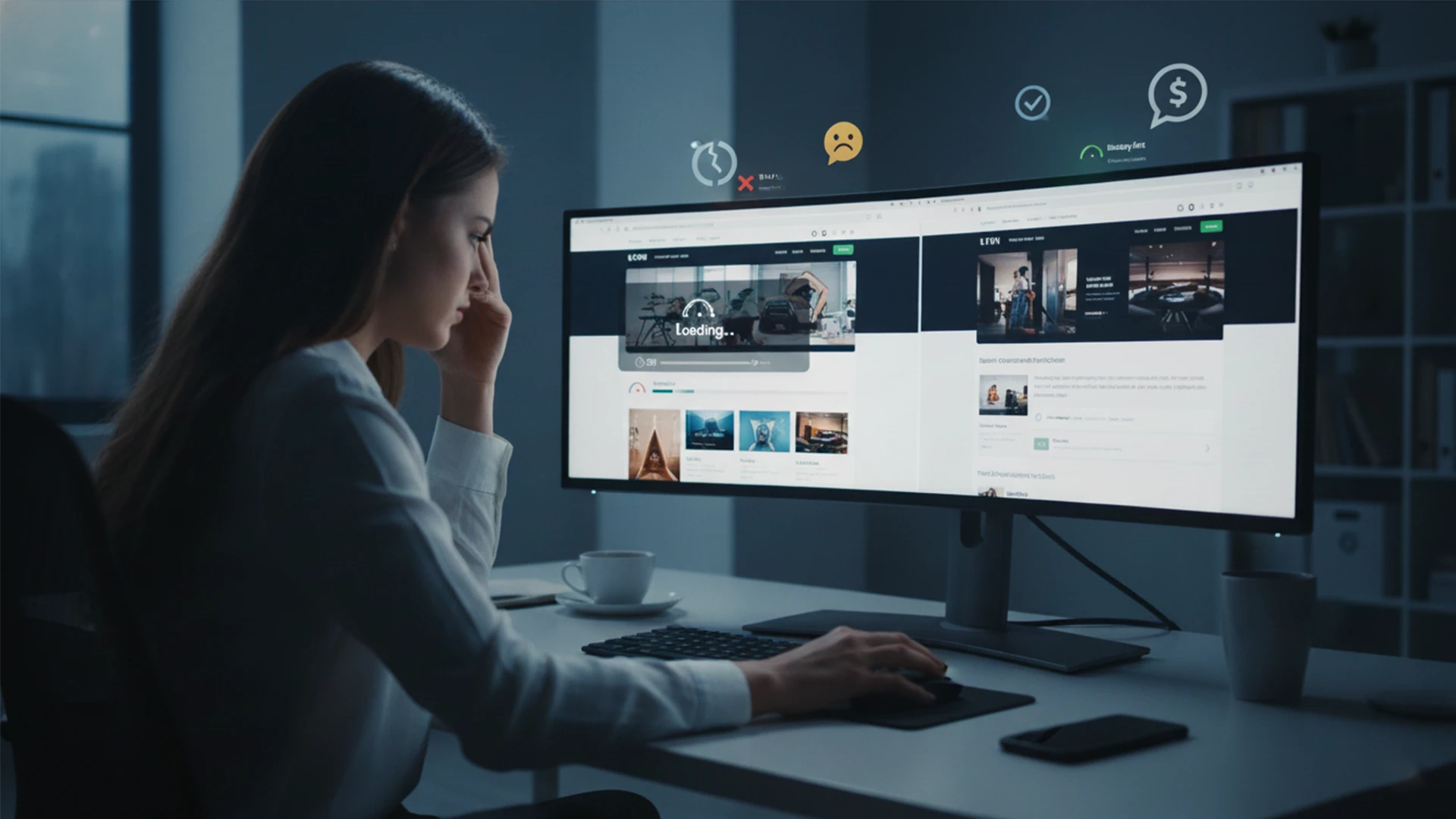
The first instance I encountered where a beautifully designed website crumbled under its own weight, spinning loaders, lagging animations, broken scripts, I realized something simple but brutal: beauty means nothing if it’s slow.
We talk about colors, typography, and layout as if they define design. But design isn’t just what you see. It’s how it feels and how fast it feels. That’s the invisible layer of web design most people underestimate: performance optimization.
Why Website Speed Defines User Experience
The thing is that users do not give a lot of thought to how hard you worked on your gradients or hero banners. They are concerned whether your site is responsive.
Google claims that 53 percent of mobile users give up on a site that requires over 3 seconds to load. Three seconds. There is no more time than that to impress, create value and gain trust.
However, thousands of sites in 2025 will not understand this fact, and instead overload their sites with large images, videos that cannot be optimized, and bloated code that suffocates users. The irony? The same brands are paying millions of money in marketing to refer traffic to a website that is not properly loaded.
Fast design is not a measure of seeking metrics. It is about being respectful of the time of your user.
Designing for Humans, Not Benchmarks
We discuss the Core Web Vitals a lot, such as Largest Contentful Paint (LCP), First Input Delay (FID), and Cumulative Layout Shift (CLS). Only here people forget it: they are not numbers that Google can evaluate you on.
They are indicators of human frustration.
A slow load means impatience. Late tap implies irritation. Lay out movement translates to distrust.
Optimization of performance is not playing a game with an algorithm, but it is creating to be empathetic. We are saying, “I value your time enough to make this smooth.”
It is the UX design in the real sense.
The Philosophy Behind Fast
Let’s zoom out for a moment.
Why do we obsess over performance? Why then does it even matter shaving off 200 milliseconds?
Because speed creates flow. And flow is the condition that the users do not remember that they are using technology in the first place. The page vanishes out of existence, they are simply in the experience.
This is what the most ideal design can do: a frictionless moment between the user and their goal.
And that is made possible by performance.
A Realization: Who Builds Like This?
A few months ago, I started exploring who’s really doing this right who’s building websites that move like thought.
That’s when I came across Newton Byte, a tech company that treats web performance like architecture structure first, aesthetics second.
They do not follow trends; they create experiences. They discuss with the same enthusiasm as aesthetics their developers the subject of server response budgets and lazy loading strategies and code modularity.
This is what struck me the most because they thought that it was not about building a fast site, but rather designing it inside it out.
It is difficult to find a company which does not consider performance as such a secondary aspect, but rather as the definition of a good design.
Data Meets Design
Consider this:
- A 1-second delay in page response can lead to a 7% reduction in conversions.
- 79% of dissatisfied shoppers who dislike the performance of the websites are less inclined to make a repeat purchase.
- Amazon at one time even stated that even a single 100ms latency cost them 1 percent on sales.
It is not just some numbers but they are a reflection of the modern thinking of users. With speed being the new satisfaction standard, performance optimization is no longer a luxury, it is survival.
When Function Feels Like Art
The most effective websites are not only technically efficient, they are alive.
The transitions are smooth, the buttons revert immediately, pages do not reload, and everything is simply working.
That feeling of easygoingness? This is how performance design is supposed to be.
Invisible art is its, such as the silence between notes which comprises the music.
Once a user does not ever see your loading time, then it is time to say that you have mastered it.
The Final Thought
Great design does not require attention, it subtly obtains it through functionality.
Web design has been reduced to the soul of performance optimization in an era of excessive design, the homework that transforms beauty into something.
Perhaps that is what design has actually evolved: it is not how it looks anymore, but how it feels.
And in case you are wondering who is leading that shift, you will find those who are performance oriented in building.
You might find Newton Byte among them.